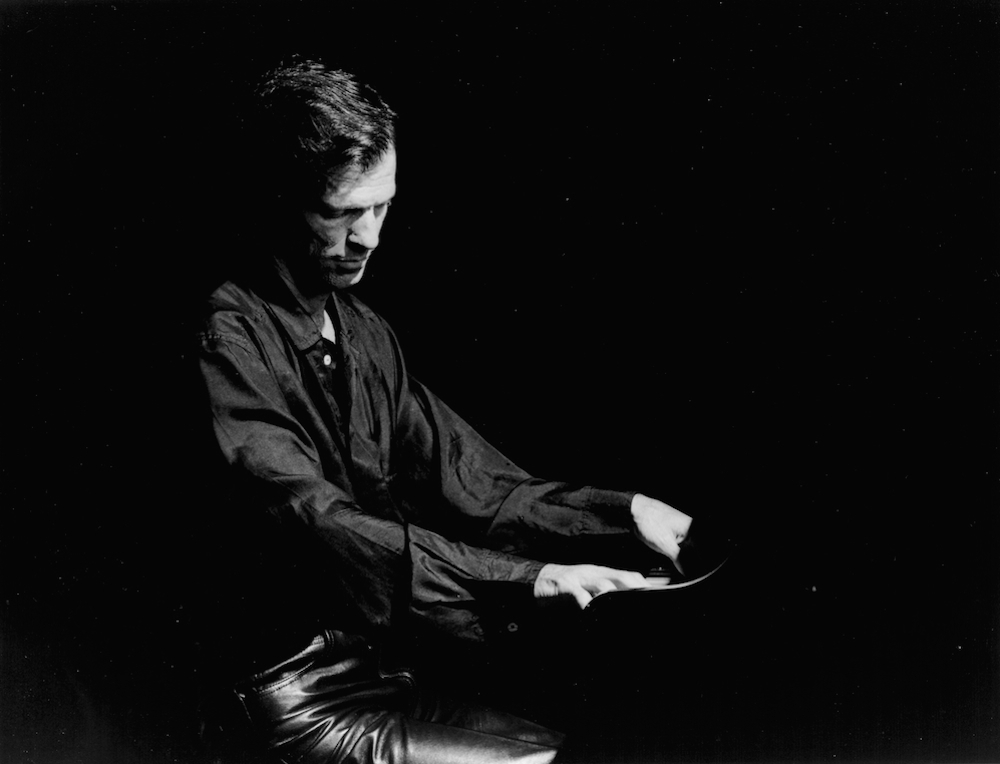
CAGE RECITAL, 05.03.12

Stephen Drury performs a solo, all-Cage program at the New England Conservatory, concluding with Etudes Australes, Book 3 (1974-75).

Thursday, May 3, 2012 at 8:00 PM Jordan Hall at New England Conservatory 290 Huntington Avenue, Boston, MA.

Program:

Prelude for Meditation (1944)
Cage is still noticeably under the influence of Satie in this early miniature for prepared piano.

In a Landscape (1948)
Using muted piano, Chinese cymbal, and two variable-speed turntables playing a frequency record and a constant note record, this is believed to be one of the earliest electroacoustic works ever composed.

from Music for Piano (1953-1956)
With this body of work, Cage began a series of giant steps to remove traces of intention or "authorship" from his works for piano. The random imperfections that occur in paper due to its organic source as fiber pulp became notation. Anywhere Cage could see an imperfection, he drew a note onto the score paper, fall where it may. All other performance decisions are left to the performer: duration and intervals between notes, how the note is struck by the performer, etc.

Solo from Concert for Piano and Orchestra (1957)
The parts of this Concert are inherently performably as solos or in other combinations, since there is no overall score. The piano part alone covers 63 score pages and uses 84 different notations and compositional techniques, with primacy given to chance operations, indeterminacy, and interpretive variety.

Etudes Australes, Book 3
Relatively late in Cage's output, Etudes Australes (1974-75) consist of four books containing eight etudes apiece. The single tones and chords of the score are derived from the star charts of the title, i.e. the constellations of the southern latitudes in the Atlas Australis. All interpretive possibilities are unscored and are left to the performer to invent. The fact that a single pianist is performing "duets for two independent hands" increases the challenge of performing these works, which also are sequenced in increasing order of difficulty.


CAGE IN POLAND, 03.20.12

Poland clearly loves Cage, having just had Cage celebrations in Lublin. The Cage Centennial continues in Poland with a John Cage Music Festival at the Karol Lipinski Music Academy in Wroclaw. The festival will consist of concerts, lectures, panel discussions, and meet-and-greets with the artists. Stephen Drury will give a solo recital of Cage's Etudes Australes Book III, alongside the "Concord" Piano Sonata No. 2 by Charles Ives, on Tuesday, March 20, 2012 at 19.00 in Marianum Oratory Hall at the Academy.

Other artists will include Agata Zubel, Rafal Augustyn, the Academic Symphony Orchestra, the Wroclaw Philharmonic Choir, Bugaj Alexander, Alexander Pavlovsk, Zuzanna Tobis, Martin Misiak, and students of the Academy. Free admission to all events.


CAGE AT ISSUE PROJECT ROOM, 02.24.12

This Thursday, February 24th, Stephen Drury performs John Cage's In A Landscape (1948) and Etudes Australes (1974-75) at ISSUE Project Room at their new space, 110 Livingston in Brooklyn, NY. Steve has recorded a vast majority of Cage's works; among them is the seminal disc In A Landscape, of which the title is the first track. For those who may not be familiar with In A Landscape, the piece captures a simple, yet sublime quality, in creating a sustained and resonant musical space -- in many ways it is quite similar to Cage's Dream (also on the CD). Written nearly thirty years later, Etudes Australes was composed in 1974-1975, and the piece consists of a total of 32 Etudes, which is then organized into 4 books, each book having 8 Etudes. The methodology that structures the work was derived from star charts of the Atlas Australis. Apart from its conventional notation on staves, the player is free to interpret the notes in dynamics, pedal instructions, and so forth.

Also on the bill is Collide-O-Scope Music, performing music by Terry Riley, Karlheinz Stockhausen, and Philip Glass. More detailed information can be found at ISSUE Project Room's listing.


GREEK REVIEW, 2012 CAGE


Described as "a piano devil... diving deep in the secrets of the art and the instrument", Stephen Drury returns from Europe with a rave review written by Haris Simvoulides, who describes the concert as one of "the most important concert performances of the current year [in Athens]". Having just performed with Frederic Rzewski at the Festival d'Automne in Paris, Drury arrived in Athens on November 21st to perform Cage and Ives to "overbooked festivals" and otherwise full houses. "In the Etudes Australes we had the opportunity to admire how Drury was mastering an extremely difficult piece - for both the interpreter and the listener. For the interpreter the movements required for the execution of the piece are mostly those of an acrobat than of a pianist: Cage, by composing this piece, searched the impossible, producing notes and chords based on austral maps of the southern hemisphere firmament." As far as the Ives, Simvoulides described Drury's performance as "stunning in all four parts... in a piece with very many diversified demands on execution and emotional level... Drury's performance shone...". Read the full review in Greek here.

Looking ahead to 2012, Stephen Drury will perform at the Ludwig van Beethoven Institute in Vienna, Austria this coming February, where he will provide numerous Cage treats for audiences there: lectures, masterclasses, and a culminating recital of the music of John Cage (marking just the beginning of a Cage-filled Centennial). And to close 2011 with some exciting news: the John Luther Adams CD release, Four Thousand Holes, has been listed as one of the top 10 "Best Classical Music Recordings of 2011" in the New Yorker as recommended by music critic Alex Ross. Happy Solstice & holidays to all!

(photo by Aigli Drakou)


CAGE IN PARIS, ATHENS

This Saturday, November 19th, Stephen Drury performs John Cage's Etudes australes with Frederic Rzewski at the Festival d'Automne a Paris in Paris, France. Composed in 1974-1975, the piece (a total of 32 Etudes, organized into 4 books, each book having 8 Etudes) consists of single tones and combinations derived from star charts of the Atlas Australis. Though notated on conventional staves, there are no dynamic markings nor pedal instructions, and the player is free to interpret the notes given.

"Etudes australes (almost four hours) is a tribute to the final Paris performance of the Merce Cunningham Dance Company. A duo for two independent hands, it has them struggle with complex chords. Elements were set according to stars in the southern skies and the I Ching, then defined as a computer program. The pianist decides on speed and dynamics. Diabolical virtuosity is proof of and just reward for effort." -- (festival-automne.com)

On Monday, November 21st, Drury heads to Athens, Greece where he performs a solo recital of Cage'sEtudes Australes alongside Charles Ives's Concord Sonata, as part of the Pianoscapes series curated by Lorenda Ramou at the ABOUT: Cultural Venue. More information can be found here.


PRAISE FOR BARTOK WITH NEW ENGLAND PHILHARMONIC

From the Boston Musical Intelligencer: "Stephen Drury was the admirable soloist, whose playing of this last work penned by Bartok was pellucid, accurate, wonderfully nuanced, fiery and atmospheric... Often cited as the most accessible of the composer's three piano concertos, it is nonetheless filled with abundant demands of the pianist's virtuosity and imagination. Bartok's great interest in Hungarian folk music is audible in the work's first and third movements, and Drury played those moments with great dash and elan. The second movement is notable for its inward direction, its chorale-like writing reflecting the composer's "Andante religioso"; here, as elsewhere, Drury and the orchestra were hand-in-glove in their exposition of the score... These and all of the pure Bartokian measures were sparklingly essayed by Drury, who surely made as strong a case for this wonderful music as one could imagine."

Read the complete review here.